Taming Agents in the Wild: What It Really Takes to Put Agentic AI into Production
From promising AI experiments to dependable business operations, the real challenge is not building an agent. It is making it work reliably in the real world.
Agentic AI is moving quickly from experimentation into enterprise environments. But taking an AI agent from a successful pilot to a production-ready system involves far more than choosing the right model or building an impressive workflow.
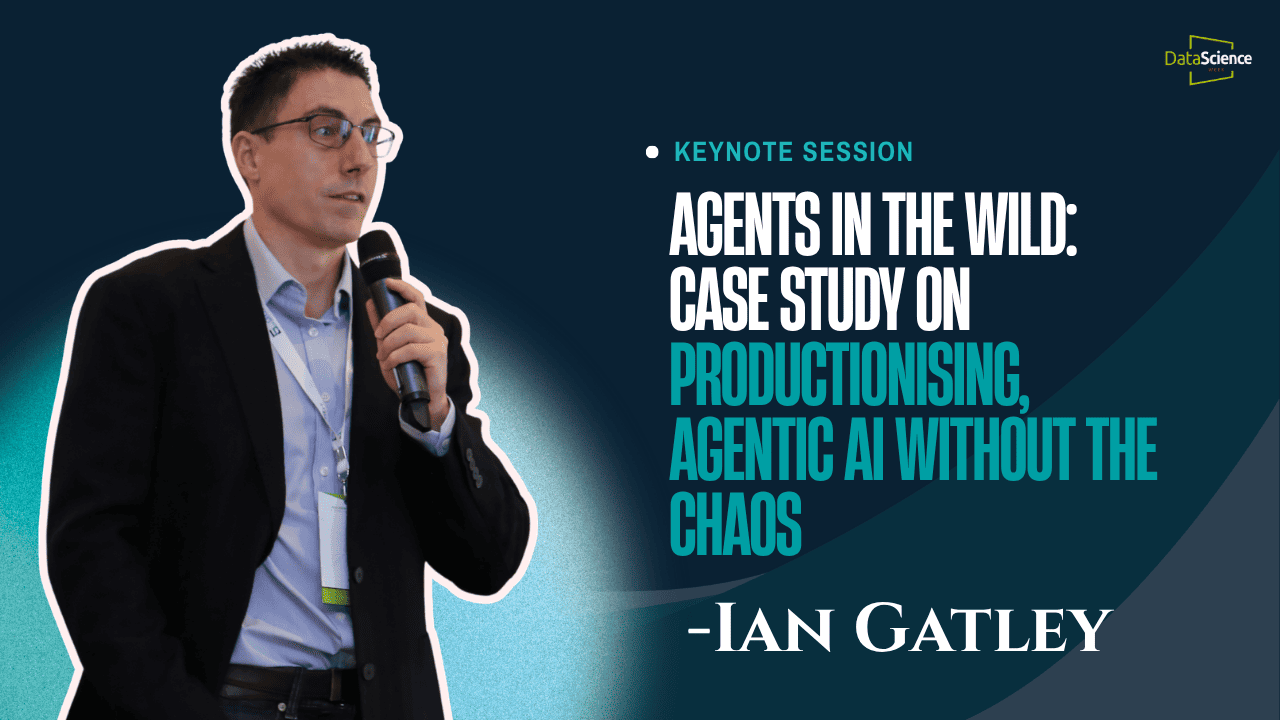
At the 4th Data Science & AI Summit in London, #IanGatley, Group Chief Technology Officer at Vector Investment Capital, UK, explored this challenge through a practical case study in his keynote, “Agents in the Wild: Case Study on Productionising Agentic AI Without the Chaos.”
His presentation offered a grounded look at what happens when agentic AI meets the complexity of real business processes.
Start with the business problem, not the AI
One of the central lessons from Ian’s case study was the importance of understanding the business process before introducing AI.
In specialist insurance workflows, a single submission can involve hundreds of pages of documents, spreadsheets, technical reports, photographs and correspondence. Every case is different, and missing information can have significant consequences.
Rather than simply adding AI to an existing workflow, the approach focused on redesigning the process around a clear operational outcome: reducing the time needed to make a risk submission quote-ready.
This is an important distinction for organisations exploring agentic AI. The objective should not be to deploy agents for the sake of innovation, but to solve a measurable business problem.
The balance between agents and human judgement
Another key principle was clear: humans initiate, agents execute, humans validate.
The case study demonstrated how agents could handle repetitive tasks such as extracting information, processing attachments, organising records and preparing workflows, while people remained responsible for reviewing and confirming critical information.
This approach keeps employees involved in decisions that require judgement and accountability, without making them responsible for every repetitive operational step.
It also highlights an important factor in enterprise adoption: people are more likely to trust systems they can see, understand and intervene in.
Governance cannot be an afterthought
Moving AI agents into production requires more than a functioning model. Monitoring, testing, version control, permissions, audit trails and rollback mechanisms need to be considered from the beginning.
Ian emphasised the importance of building operational controls into the system from day one, rather than trying to retrofit governance once the solution is already in use.
The lesson is particularly relevant as organisations begin deploying agents across processes where reliability, traceability and accountability matter.
Production is an ongoing journey
The case study also showed that productionising agentic AI is not a one-time implementation exercise.
The system evolved through several stages, from an initial pilot to wider deployment across teams. In the August 2026 production snapshot shared in the presentation, the workflow was live across all teams, processing around 50 submissions weekly, with approximately 38 fields extracted and human validation retained.
But the journey was not presented as a finished success story. Complex submissions, model-provider failures and changing technology choices remained challenges.
That is perhaps one of the most valuable lessons: successful AI systems need continuous evaluation, adaptation and improvement.
The bigger takeaway
Ian’s presentation brought the discussion beyond the excitement surrounding autonomous agents and back to the realities of enterprise implementation.
A few principles stood out:
- Start with a business process, not an AI use case.
- Keep human validation and accountability in the workflow.
- Build governance, monitoring and audit into the system from day one.
- Redesign inefficient processes before automating them.
- Expect architecture and technology choices to evolve.
- Recognise that adoption moves at the speed of trust.
The future of enterprise AI will not be defined simply by how autonomous agents become, but by how reliably organisations can put them to work.
Our thanks to Ian Gatley, Group Chief Technology Officer at Vector Investment Capital, for bringing a practical, experience-led perspective to the summit and sharing lessons from the realities of deploying agentic AI in production.
This article draws on the keynote presentation delivered at the 4th Data Science & AI Summit, London.